United Arab Emirates - Republic of Korea Comprehensive Economic Partnership Agreement


Overview
UAE-Korea Comprehensive Economic Partnership Agreement
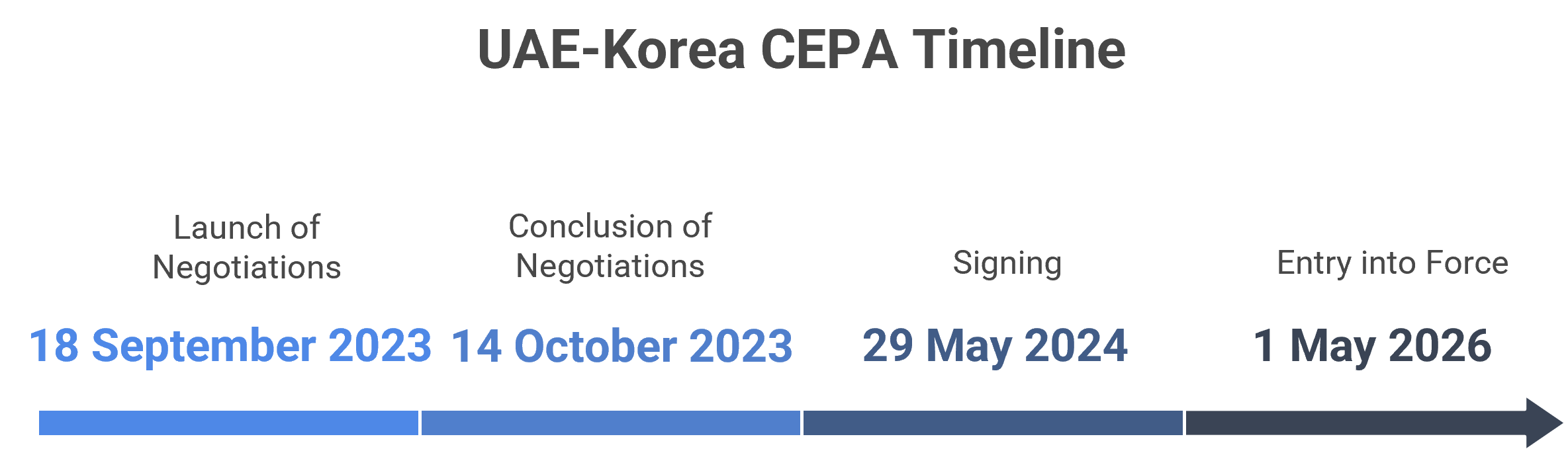
The Comprehensive Economic Partnership Agreement (CEPA) between the United Arab Emirates and the Republic of Korea was signed on 29 May 2024 and entered into force on 1 May 2026.
The UAE–Republic of Korea CEPA reflects the Parties’ shared vision to advance sustainable economic growth through enhanced trade, investment, and deeper economic cooperation.
The CEPA establishes a modern, high-standard framework to deepen trade, investment, and economic cooperation between the two countries.
Under the CEPA, more than 90% of tariffs on trade in goods will be eliminated over a period of up to 10 years, thereby reducing the cost of imports and enhancing market access for producers and traders from both countries.
The CEPA is expected to diversify bilateral trade, address non-tariff barriers, strengthen trade in services, and facilitate bilateral investment flows.
The CEPA further establishes structured pathways to strengthen economic relations and cooperation across a range of priority sectors, including energy, natural resources, and advanced industries.
Caption
UAE President His Highness Sheikh Mohamed bin Zayed Al Nahyan and His Excellency Yoon Suk Yeol, President of the Republic of Korea, witnessed the signing of the Comprehensive Economic Partnership Agreement during an official ceremony held in Seoul on 29 May 2024.
The CEPA was signed by H.E. Dr. Thani bin Ahmed Al Zeyoudi, Minister of Foreign Trade of the UAE, and H.E. Ahn Duk-geun, Minister of Trade, Industry and Energy of the Republic of Korea.
CEPA Coverage
The UAE–Republic of Korea CEPA comprises 18 chapters and their respective annexes, covering a broad range of areas including trade in goods and services, investment, and strategic economic cooperation. That is supported by an institutional framework for administration and implementation of the CEPA, as well as a mechanism for the settlement of state-to-state trade disputes.
Market Access for Goods
The CEPA delivers significant tariff liberalisation across trade in goods, eliminating or reducing customs duties on a substantial majority of tariff lines.
Pursuant to the UAE–Republic of Korea CEPA, the Parties undertake tariff liberalisation commitments covering approximately 91.2% of tariff lines, with duties to be progressively eliminated in accordance with each Party’s Schedule of Tariff Commitments over a period of up to 10 years.
This in addition to binding disciples ensuring national treatment, the elimination of non-tariff restrictions, and the transparent and predictable administration of import and export measures in line with WTO obligations, will enhances market access for exporters and reduces costs for businesses and consumers.
For detailed information on preferential tariff rates, please review the CEPA Market Access Dashboard below.
Rules of Origin (RoO)
To determine eligibility for preferential tariff treatment, the CEPA establishes transparent and business-friendly rules of origin (RoOs), providing clear and flexible criteria supported by procedural requirement to ensure certification verification that support export growth and the development of regional and global value chains.
These criteria vary depending on the type of goods. For manufactured products, the CEPA adopts a “sufficient working or processing” rule, which may be satisfied either through a change in tariff classification or where the product undergoes processing that results in a value content of not less than 40% of the product’s Free on Board (FOB) price. In addition, the RoOs include product-specific rules for certain goods.
To issue the COO, please refer to the link below.
Customs Procedures and Trade Facilitation
The CEPA streamlines customs processes by promoting transparency, advance rulings, risk management systems, and efficient border procedures, reducing administrative burdens and accelerating the movement of goods.
Product Health and Safety
The CEPA establishes disciplines to ensure that sanitary and phytosanitary measures (SPS), as well as technical regulations, standards, and conformity assessment procedures, are based on international standards, applied in a transparent and non-discriminatory manner, and do not create unnecessary obstacles to trade, while preserving each Party’s right to protect human, animal, and plant life and health.
Trade Remedies
Under the CEPA, the Parties reaffirm their WTO rights and obligations with respect to anti-dumping, countervailing, and global safeguard measures, while enhancing transparency and due process. The CEPA further provides for the possibility of applying a bilateral safeguard measure. This allows am injured Party to temporarily suspend tariff reductions or increase duties where, as a result of tariff liberalisation under the CEPA, imports of a good increase in such quantities as to cause or threaten to cause serious injury to that Party’s domestic industry. In such circumstances, the affected Party subject to the conduct of an investigation may temporarily deviate from the agreed preferential tariff treatment.
Market Access for Services
The CEPA establishes binding market access and national treatment commitments across a range of specified service sectors, in accordance with each Party’s Schedule of Specific Commitments.
These commitments are supported by disciplines on domestic regulation, ensuring that licensing and qualification requirements, as well as approval procedures, are administered in a transparent, objective, and impartial manner.
The CEPA expands opportunities for services suppliers by improving access and legal certainty in key sectors, including professional services, telecommunications, financial services, transport and logistics, and tourism. It also includes dedicated provisions on telecommunications and financial services, which promote competitive markets, regulatory transparency, and non-discriminatory access to networks and services.
In addition, the CEPA contains provisions on the temporary entry and stay of business persons, facilitating the movement of natural persons engaged in trade in services, subject to each Party’s applicable laws and commitments.
Overall, the CEPA enables deeper services market integration and fosters investment.
Digital Trade
The CEPA strengthens the digital economy by supporting cross-border data flows, prohibiting customs duties on electronic transmissions, and promoting paperless trade, e-authentication, and digital documentation.
Intellectual Property
The CEPA enhances the protection and enforcement of intellectual property rights, supporting innovation, creative industries, and technology-driven sectors which also includes strengthened cooperation between the Parties.
Government Procurement
The CEPA sets out a comprehensive framework to open and improve government procurement markets in each Partners within set thresholds and exclusions as well as for specific covered entities, which for the UAE market opening is limited to Federal level entities.
Investment Facilitation
The CEPA facilitates bilateral investment cooperation by improving transparency, encouraging dialogue and exchange of information to foster a stable and predictable investment environment.
Economic Cooperation
The CEPA establishes a structured framework for enhancing collaboration in areas such as capacity building, technology transfer, and innovation across a number of priority sectors, including agriculture, healthcare, energy, and advanced industries.
Economic cooperation under the CEPA provides for the development of joint initiatives and an agreed programme of activities aimed at delivering tangible economic benefits for both Parties.
Small and Medium-Sized Enterprises (SMEs)
The CEPA provides specific attention to ensure the participation of small and medium-sized enterprises (SMEs) in bilateral trade and investment.
The CEPA promotes cooperation in areas such as information sharing, capacity building, and the development of networks linking SME support institutions, with a view to enhancing competitiveness and access to international markets.
The Chapter also provides for the development of accessible tools and resources, including online information platforms, to help SMEs better understand and benefit from the opportunities created by the CEPA that foster the growth and internationalisation of SMEs.
Agreement Administration and Cross-Cutting Provisions
The CEPA puts in place administrative and communication structures comprised of designated focal points, a joint committee and subcommittees that meet regularly and are tasked with the management and implementation of the different aspects of the CEPA.
The CEPA contains key cross cutting disciples that maintain each Partner’s right to take measures in exceptional cases to protect human life and health and for public moral or security reasons.
Benefits
- Provides for tariff liberalization, as the CEPA eliminates or reduces customs duties on over 90% of the value of bilateral trade flows.
- Introduces flexible and business-friendly rules of origin, making it easier for companies to qualify for preferential access.
- Streamlines customs procedures and reduces administrative burdens, which lowers trade costs and speeds up logistics.
- Creates new openings service suppliers, particularly in professional services, ICT, finance, logistics, tourism, and creative industries, supported by clearer market-entry disciplines and more predictable regulatory frameworks.
- Strengthens the digital trade environment, ensuring non-discriminatory treatment of digital products, enabling cross-border data flows, promoting e-invoicing, e-authentication and paperless trade, and supporting a secure, trusted online marketplace for consumers and businesses.
- Supports innovation and knowledge-based industries through enhanced protection and enforcement of intellectual property rights, cooperation between IP authorities, and mechanisms that encourage technology transfer and creative-sector growth.
- Promotes and facilitates investment flows by enhancing transparency, streamlining administrative procedures, and fostering regulatory cooperation, thereby creating a stable and predictable environment for investors.
- Enhances economic cooperation in strategic sectors by supporting joint initiatives, capacity building, and technology transfer across priority areas, towards tangible economic benefits for both Parties.
The Korea CEPA includes 18 chapters
The UAE-Korea CEPA Market Access Dashboard
UAE exporters can now benefit from greater market access through preferential tariff rates. Some products will be subject to zero tariffs from day one of entry into force of the CEPA, while some others will be reduced over time, as per the dashboard. To determine the tariff classification (HS code for your product), review the dashboard, find the tariff line description that best represents your product, and view the preferential tariff rate for your product and estimate the charges.
COO


Ministry of Economy's Unified Number
800 1222

Contact via WhatsApp
+971 800 1222Screen resolution should be 1280x1024 for best browsing experience. Browser Compatibility: IE 11.0+, Firefox 35.0+, Safari 5.1+, Google Chrome 39.0+.
Page was last updated on:
22 Sep 2026 6:03:59 AM