UAE-Azerbaijan Comprehensive Economic Partnership Agreement


Overview
UAE-Azerbaijan Comprehensive Economic Partnership Agreement
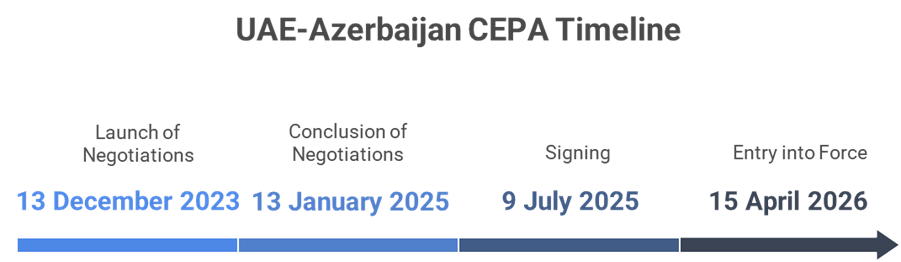
The UAE–Azerbaijan Comprehensive Economic Partnership Agreement (CEPA) was signed on 9 July 2025 and entered into force on 15 April 2026.
The CEPA is a next-generation economic integration agreement designed to go beyond tariff liberalisation and establish a long-term platform for trade diversification, investment expansion, supply-chain integration, and digital economic cooperation.
The CEPA connects two strategically positioned economies: the UAE as a global logistics, finance, and re-export hub, and Azerbaijan as a gateway to the Caucasus, Central Asia, and Caspian energy and transport corridors.
The CEPA is a significant milestone in UAE-Azerbaijan relations, underscoring the two nations’ shared aspirations to build a resilient, knowledge-based, and innovation-driven economy that meets future demands.
Caption
UAE President His Highness Sheikh Mohamed bin Zayed Al Nahyan and His Excellency Ilham Aliyev, President of the Republic of Azerbaijan, witnessed the signing of a Comprehensive Economic Partnership Agreement (CEPA) in Abu Dhabi on 9 July 2025
The CEPA was signed by His Excellency Dr Thani bin Ahmed Al Zeyoudi, UAE Minister of Foreign Trade, and His Excellency Mikayil Jabbarov, Minister of Economy of Azerbaijan.
CEPA Coverage
The UAE–Azerbaijan CEPA consists of 18 chapters and their annexes. It eliminates tariff barriers and enhances market access for trade in goods and services. The CEPA also places special emphasis on the needs of small and medium-sized enterprises (SMEs) and seeks to strengthen economic cooperation across multiple sectors, with the aim of driving joint economic growth, diversification, and prosperity as part of the strategic relationship between the UAE and Azerbaijan.
Trade in Goods
The UAE–Azerbaijan CEPA provides for the tariff elimination or reduction on more than 95% of all qualifying goods made in Azerbaijan or in the UAE, including those from free zones. Trade in goods is also supported by clear rules on customs duties, import licensing and treatment of non-tariff barriers.
For detailed information on preferential tariff rates, please review the CEPA Market Access Dashboard below.
For goods to qualify for preferential tariff treatment, they must meet the Rules of Origin requirements that are flexible and seek to enhance two-way trade between the two Partners. CEPA supports the flow of goods in a simple, less costly, and timely manner through trade facilitation and customs cooperation arrangements.
The CEPA puts in place rules to ensure that product health and safety requirements are in line with international standards and do not become a barrier to trade.
CEPA reinforces the principle of fair trade by allowing for temporary relief against unfair trade or unforeseen surges in imports in accordance with the WTO agreements covering safeguards, subsidies, countervailing duties, and anti-dumping measures, as well as allowing for bilateral safeguard measures.
The CEPA unlocks new export opportunities by ensuring duty-free or preferential market access, transparency in customs procedures, and the removal of unnecessary regulatory barriers.
To ensure the smooth functioning of the CEPA, the Partners have established a standing Subcommittee on Trade in Goods that monitors implementation and addresses any emerging issues.
Trade in Services
The CEPA sets clear and transparent rules to facilitate the cross-border supply of services and movement of natural persons.
The CEPA ensures that service providers enjoy favourable treatment across a variety of service sectors and subsectors, including professional services, financial services, logistics, travel and tourism, transport services as well as telecommunication services where the Partners have agreed specific disciplines to support the growth of bilateral trade.
The CEPA includes detailed schedules of commitments for both the UAE and Azerbaijan, which can be seen in the Annexes to Chapter 8 of the Agreement.
Digital Trade
CEPA promotes cross-border digital trade and e-commerce by allowing for open data flows, recognition of electronic signatures, and consumer protection in the digital environment. The common disciplines contained in the CEPA bring greater coherency to a continuously evolving digital trading landscape integral to today’s global economy and serve to enhance confidence and ensure that digital trade flows benefit both businesses and consumers.
For UAE and Azerbaijani businesses alike, this CEPA creates a trusted digital bridge connecting two of Asia’s most dynamic economies and offering new opportunities for e-commerce, fintech, logistics, creative industries, and government-tech partnerships in an increasingly digitalized global marketplace.
Investment
CEPA reaffirms each Partner’s commitment to the protection of investment under the 2006 Bilateral Investment Agreement, and the Partners’ goals to promote and facilitate investments, including through publication of investment legislation and sharing of information.
The CEPA establishes a dedicated technical council to enhance investment flows, and tackle investment matters.
Government Procurement
The CEPA establishes contact points and creates a mechanism for cooperation between the Partners. The CEPA promotes transparency and fair competition in government procurement processes, by ensuring that suppliers from both Partners have access to information on public tenders on a non-discriminatory basis, as well as having access to legislation and procedures.
Intellectual Property Rights
CEPA complements existing international principles and standards for the treatment, protection, and enforcement of Intellectual Property Rights (IPRs) in a manner that provides greater confidence in protecting innovations, brands, and creative works, thereby encouraging innovation, technology transfer, and investment in creative industries.
Economic Cooperation
CEPA promotes cooperation and collaboration among the Partners to support stronger economic ties and ensure that businesses can fully benefit from the opportunities made possible by the CEPA.
Small and Medium-Sized Enterprises (SMEs)
CEPA recognizes the specific needs of SMEs and seeks to make it easier for SMEs and entrepreneurs to grow their businesses and attract investment by providing information and putting in place joint platforms to assist SMEs in developing linkages and building capacities.
Dispute Settlement
The CEPA’s state-to-state trade dispute settlement mechanism underscores the Partners’ commitment to resolving trade disputes in a timely manner that preserves the levels of trade liberalization and benefits the economy.
Agreement Administration
CEPA establishes an administrative structure that is comprised of a specialised committee and subcommittees, as well as contact points, which ensures effective communications as well as being tasked with managing and overseeing the implementation of the different aspects of the CEPA.
Benefits
- Provides tariff elimination and enhanced market access, as under the CEPA, the UAE commits to remove tariffs on 99% of Azerbaijani exports, and Azerbaijan commits to remove tariffs on 98.5% of UAE originating goods.
- Helps make trade smoother and reduces cost of compliance, as the CEPA streamlines customs procedures and simplifies product requirements, in the areas of technical barriers to trade (TBT), sanitary and phytosanitary measures (SPS), and contains clear and simple rules of origin.
- Diversification of supply chains and sourcing opportunities. The CEPA opens Azerbaijan to partnerships with UAE manufacturing, processing and logistics firms.
- Provides new opportunities for growth in services trade and investment expansion, as the CEPA includes commitments on services liberalisation and investment facilitation.
- Strengthens the online environment for businesses and consumers to securely engage in digital trade.
- Supports innovation by strengthening the protection and enforcement of intellectual property rights.
- Promotes cooperation between the Partners in key areas of economic cooperation and support to SMEs as well as setting up pathways to engage the private sector.
The Azerbaijan CEPA includes 18 chapters
The UAE-Azerbaijan CEPA Handbook
To be shared soon
The UAE-Azerbaijan CEPA Market Access Dashboard
UAE exporters can now benefit from greater market access through preferential tariff rates. Some products will be subject to zero tariffs from day one of entry into force of the CEPA, while some others will be reduced over time, as per the dashboard. To determine the tariff classification (HS code for your product), review the dashboard, find the tariff line description that best represents your product, and view the preferential tariff rate for your product and estimate the charges.
COO


Ministry of Economy's Unified Number
800 1222

Contact via WhatsApp
+971 800 1222Screen resolution should be 1280x1024 for best browsing experience. Browser Compatibility: IE 11.0+, Firefox 35.0+, Safari 5.1+, Google Chrome 39.0+.
Page was last updated on:
26 Sep 2026 12:31:56 PM